
Greece to sign Israeli air defence deal as Ankara plans for war
Six months of war between Iran and a US-Israeli coalition have left Athens closer to Israel and Ankara openly planning for conflict.
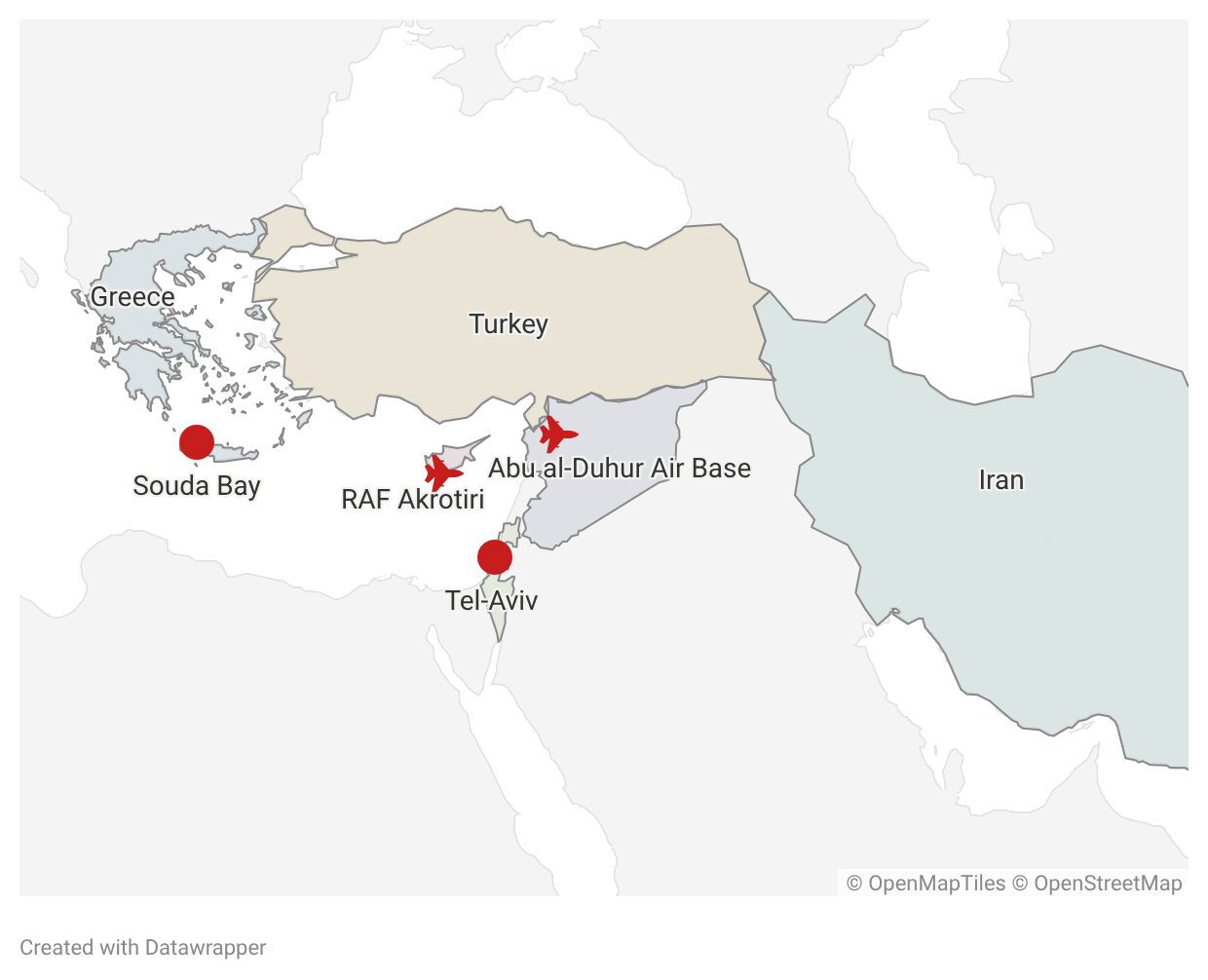
Greece is due to sign the contracts for its Achilles Shield air and missile defence network in Tel Aviv on Monday, 31 August. The Israeli daily Ynet reported on 28 August that the signature will be between procurement officials at the Greek defence ministry and SIBAT, the International Defence Cooperation Directorate at Israel’s defence ministry. The Cyprus Mail reported the same date, naming the Greek side as the defence ministry’s General Directorate for Defence Investments and Armaments. It comes six months into a war that has moved each of the four states with a stake in it — Greece, Turkey, Iran and Israel — into a position none held in February.
What is being signed, and for how much
Greece’s Government Council for Foreign Affairs and Defence, known by its Greek acronym KYSEA, approved the programme on 23 July. Defence Minister Nikos Dendias said that day that the air defence systems would cost slightly more than €3 billion (about $3.4bn), according to Breaking Defense, and that the network would be fully operational within 35 months with at least a quarter produced by Greek industry.
The architecture reported across Greek and Israeli outlets combines Rafael’s David’s Sling and Spyder systems and Israel Aerospace Industries’ Barak MX with Patriot batteries Greece already operates. Ynet reported that around 12 Greek companies would take part, their share worth more than €700m, and that access to the command system’s source code was central to the negotiation.
Athens has aligned without enlisting
Greece has not endorsed the war on Iran. In an assessment published in April, the Centre for Mediterranean, Middle East and Islamic Studies found that Athens had not authorised offensive use of its bases, had contributed no forces, and had declined the US-proposed naval mission to escort vessels through the Strait of Hormuz — while the base at Souda Bay serviced a US aircraft carrier bound for the theatre and a Greek Patriot battery remained deployed inside it.
The Greek position is shaped by shipping interests. Foreign Minister George Gerapetritis said in Berlin on 17 March that Greece opposed separate arrangements for ships entering or leaving Hormuz and wanted a lasting solution under United Nations auspices, Reuters reported. Athens has kept a line to Tehran: the Greek foreign ministry said Gerapetritis and his Iranian counterpart Abbas Araghchi spoke by telephone on August 13 and agreed to continue technical-level contacts.
The war has also cost Greece money. The Piraeus Chamber of Commerce and Industry estimated on 28 August that the first six months had cost the Greek economy about €3bn — €1.5bn in added energy costs, €600m in lost turnover, €500m in transport and supply chains and €400m in fiscal burden. The figure is the chamber’s own calculation, drawn from EU, European Central Bank, IMF, Eurostat and Hellenic Statistical Authority data.
Ankara stayed out of the war and turned to the Aegean
Turkey stayed out, but has only deepened its criticism of Israel. President Recep Tayyip Erdoğan called the US-Israeli attacks a violation of international law and sent condolences after the killing of Supreme Leader Ali Khamenei, while Ankara also criticised Iran’s retaliatory strikes on Gulf states. Foreign Minister Hakan Fidan said on March 14 that staying out was Turkey’s primary objective, the Turkey Analyst reported, after NATO air defences intercepted Iranian missiles over Turkish territory.
That neutrality has not extended to Greece. In a written answer to a lawmaker dated 10 August and released on 21 August, Defence Minister Yaşar Güler said Turkey was monitoring “all activities of Greece that violate the rights and interests of Turkey and are contrary to international law”, To Vima reported, and was closely following Greek-Israeli military cooperation. The letter was first reported by Nordic Monitor, which said the ministry described work on “possible crisis, tension and war” in Turkey’s surrounding region as continuing across state institutions. World Desk could not retrieve that page; the wording is as reported by To Vima and the Algemeiner.
Fidan, visiting Egypt this month, described the Greece-Cyprus-Israel grouping as directed against Turkey and Egypt, To Vima reported. On 7 August Turkey signed a mutual defence agreement in Mecca with Saudi Arabia and Pakistan; Fidan compared it to NATO’s Article 5 and said it was not aimed at Iran.
Tehran and Jerusalem
Tehran’s position hardened as diplomacy stalled. The 60-day deadline set by June’s memorandum of understanding expired on 17 August without a settlement. On 19 August the Financial Times, citing people close to the Iranian government, reported that Iranian forces had assessed possible strikes on US military assets in south-eastern Europe, including Bulgaria’s Bezmer air base, and that one source named Cyprus as a candidate. Iran has not confirmed this. A loitering munition struck RAF Akrotiri in Cyprus on 1 March.
For Israel, the Greek relationship is one of the few in the region moving in its favour. Its defence ministry called the partnership its highest point when the two signed a €650m rocket artillery deal in June, Nordic Monitor reported. The sharper problem is Turkey. Israel struck the Abu al-Duhur airbase in northern Syria on the night of 17-18 August, saying Damascus was about to let Turkish forces deploy there — a claim Syria’s foreign minister rejected. Tom Barrack, US ambassador to Turkey, called the strike an escalation and said Washington was working on a deconfliction mechanism.
