
Houthi strikes on Saudi test Mecca defence pact
Yemen’s Houthi movement fired ballistic missiles and drones at four cities in southern Saudi Arabia on Tuesday 8 September, wounding 73 people and starting fires that forced a temporary halt to operations at several energy facilities. Within hours, Pakistan’s defence minister raised the possibility that a mutual defence treaty signed a month earlier could be activated. What that treaty actually obliges its signatories to do is less settled than its language suggests, and the answer now matters.
Major-General Turki al-Maliki, spokesman for the Saudi-led coalition, said the attacks struck civilian and economic sites in Abha, Khamis Mushait, Jazan and Najran, and described them as a “dangerous escalation”. The Saudi energy ministry reported fires and a brief suspension of some operations. Houthi military spokesman Yahya Saree said the group had used dozens of ballistic missiles and drones against Saudi Aramco facilities and King Khalid Air Base, presenting the operation as retaliation for more than 120 Saudi strikes on Houthi-held areas over the previous three days. That last figure is the Houthis’ own count and is not independently verified.
What the Mecca pact says
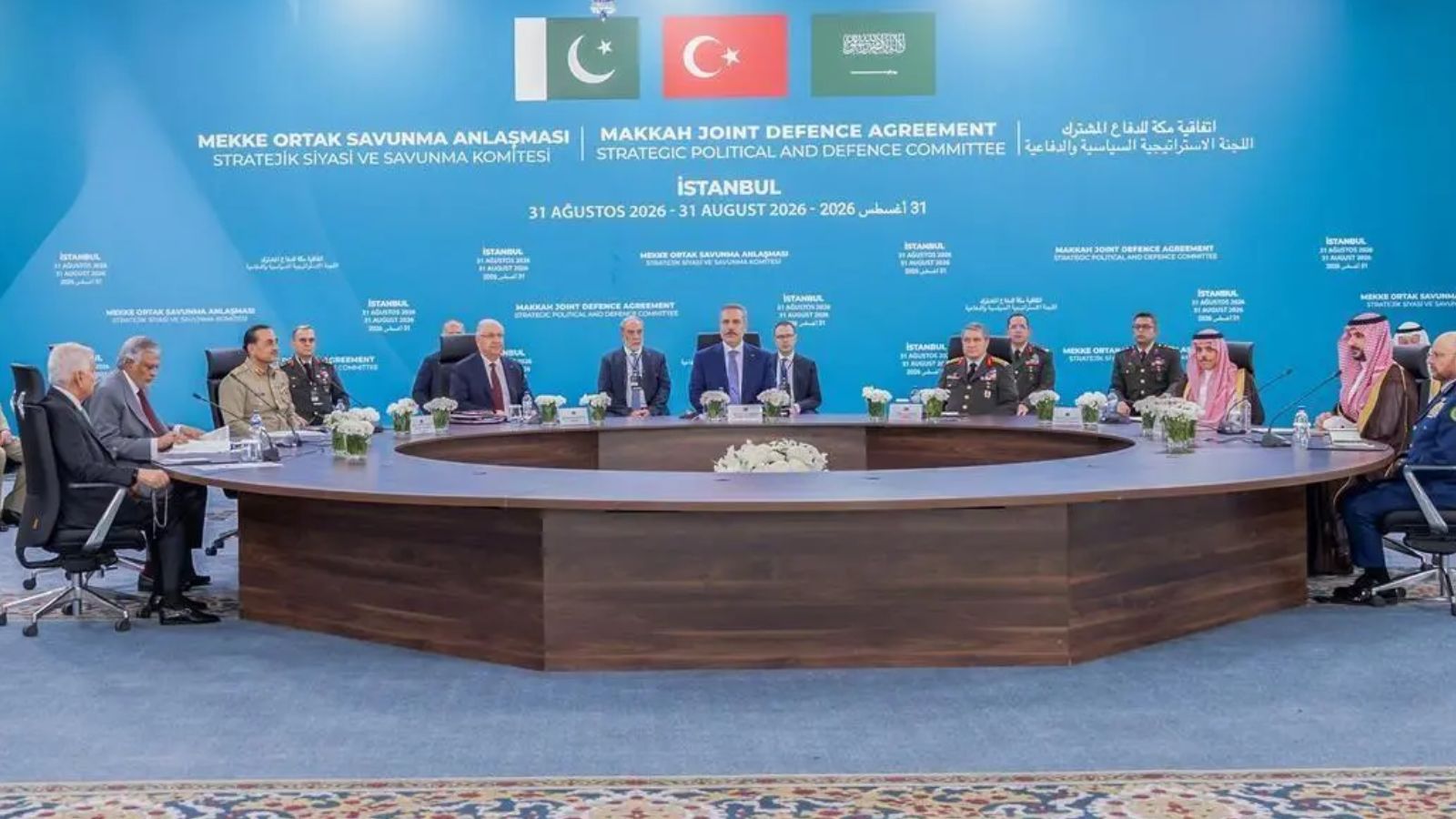
Saudi Arabia, Türkiye and Pakistan signed the Makkah Joint Defence Agreement at Al-Safa Palace on 7 August 2026. The joint statement issued by the Saudi Press Agency committed the three to treat an armed attack on any one of them as an attack on all, and to deepen defence cooperation. Meeting in Istanbul on 31 August, the signatories named the arrangement the Mecca Defence Alliance. Turkish Foreign Minister Hakan Fidan said a permanent secretariat would sit in Riyadh, with the first secretary-general drawn from Pakistan.
What the agreement does not contain is an automatic trigger. Kamran Yousaf reported in the Express Tribune on 9 September that the wording establishes a principle of collective defence and a framework for coordination rather than prescribing a particular military response to any given attack. Pakistan’s defence minister, Khawaja Asif, made the same point more bluntly on Tuesday, arguing that the three countries’ combined capability should work as deterrence: “We don’t need to respond to a brick with a stone.”
An unconfirmed report of Pakistani strikes
Against that, Türkiye Today reported this week, citing unnamed Pakistani sources, that Islamabad was weighing air strikes on Houthi positions, with clearing the group from Saada among the military priorities under consideration, and that no final decision had been taken. Outlook India, the Jerusalem Post and Free Press Kashmir all carried the report; none appears to have confirmed it independently.
Their versions differ on the point that decides the story. Outlook India renders it as Pakistan considering strikes at Saudi Arabia’s request, implying an approach has been made. Free Press Kashmir renders the same reporting conditionally — Pakistan would consider strikes if Riyadh made a formal request. Whether the pact has been invoked or merely discussed turns on that distinction, and the reporting does not settle it. Neither government has confirmed a request or any planning.
Pakistan’s public position on Tuesday was rhetorical. Its foreign ministry condemned the attacks as a violation of Saudi sovereignty and supported Riyadh’s right to defend its territory; Prime Minister Shehbaz Sharif expressed solidarity. The Express Tribune reported there was “no indication that Pakistan or Turkiye is preparing to enter the Yemen conflict” militarily — though that piece was filed before the Türkiye Today report circulated, so it is not a direct rebuttal.
Why Islamabad’s room is narrow
Pakistan has faced this choice before. Its parliament voted in 2015 against sending troops to join the Saudi-led campaign, and Islamabad has argued for a political settlement since. It is also acting as a mediator between Iran and the United States, a role that striking an Iran-aligned movement would complicate. Cutting the other way: three Pakistani nationals were killed in a Houthi attack on a commercial vessel in the Bab al-Mandeb strait in August.
Türkiye’s signal has been diplomatic. Its foreign ministry condemned the attacks in a statement dated 8 September, called on the Houthis to stop and reaffirmed support for Saudi sovereignty. That is not the posture of a government preparing to fly missions.
The war an intervention would join
Saada is the Houthi movement’s home governorate, and clearing it would be a campaign objective rather than a punitive raid. Saudi forces struck the area as recently as mid-July, according to the Armed Conflict Location and Event Data Project (ACLED), an academic conflict-monitoring group.
Inside Yemen the fighting is at its worst since the 2022 truce. The World Health Organization has put casualties at about 1,078 killed or wounded, though the period covered is reported inconsistently — Al Jazeera gives it as from 24 August, Euro-Med Human Rights Monitor as 6 August to 6 September. The UN Office for the Coordination of Humanitarian Affairs (OCHA) says more than 5,600 households have been displaced across Taiz and southern Hodeidah since fighting escalated on 3 September, and that shelling of displacement sites in Marib killed two children and injured 15 people. Its $2.2bn appeal for Yemen is around 20 per cent funded. On Wednesday, Houthi spokesman Nasruddin Amer said Saudi-backed forces had carried out 32 overnight air strikes across four provinces.
The al-Hazm prison strike of 7 September shows the verification problem. The Houthis attribute it to Saudi Arabia; Riyadh has not commented. Houthi-run media initially reported seven dead, the Houthi health ministry later reported 17, and the Houthis told the Associated Press on 9 September that 23 bodies had been recovered. Euro-Med has called for an independent investigation.
Markets have moved. Brent crude passed $100 a barrel on Wednesday for the first time since July, driven mainly by US–Iran exchanges around the Strait of Hormuz, but with Saudi energy infrastructure now a demonstrated target.
Hans Grundberg, the UN special envoy for Yemen, called the escalation “extremely alarming” on 7 September. Stéphane Dujarric, speaking for the Secretary-General on 8 September, urged all parties to “exercise restraint and prevent further escalation”.
The thing to watch is procedural, not rhetorical: whether Saudi Arabia makes a formal request under the pact, and whether that becomes public. Until then the alliance’s first test is being conducted entirely in the conditional.
