Map Shows World’s Widening AI Division
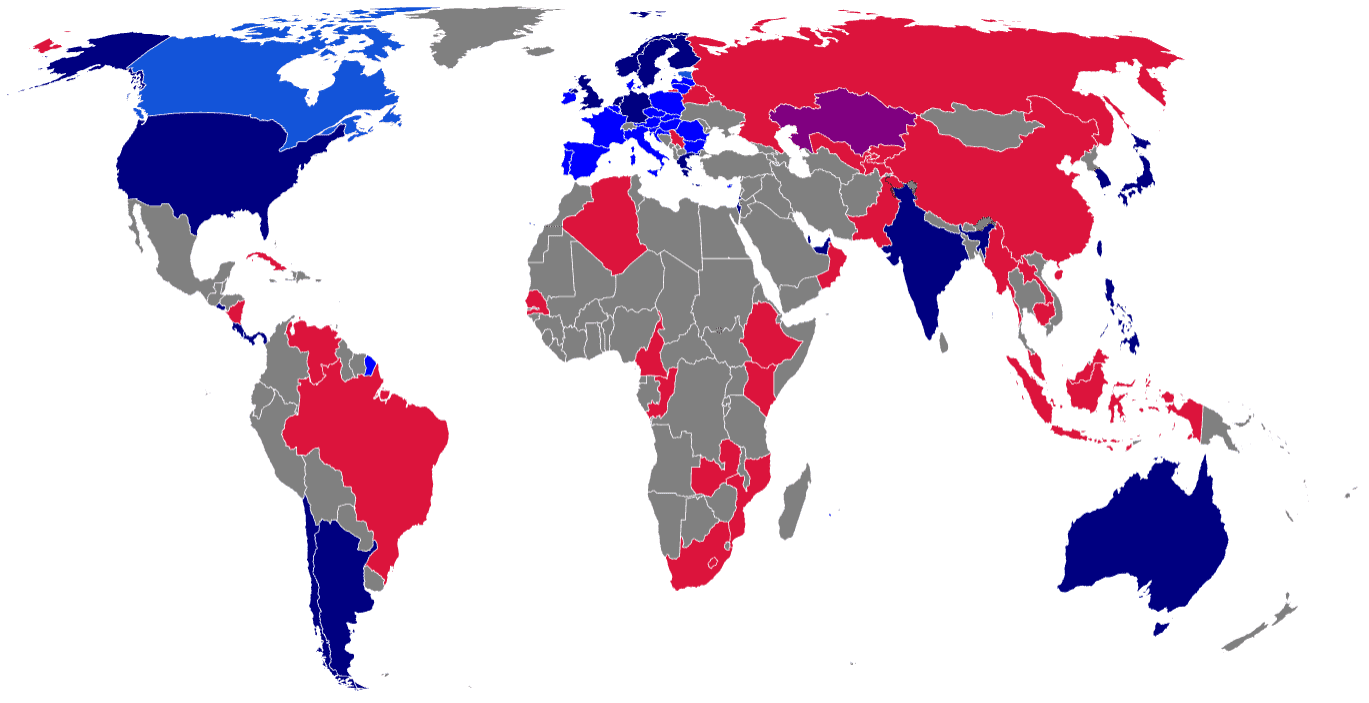
On July 16, 2026, representatives of 29 governments — including Russia, Pakistan and Indonesia— signed the founding agreement of the World Artificial Intelligence Cooperation Organization (WAICO) in Shanghai. Seven months earlier, on December 11, 2025, the United States and an initial group of partners signed the Pax Silica Declaration in Washington. Between those two signing ceremonies, artificial intelligence acquired something it has never had before: two formal, competing institutional homes, each anchored by a superpower. This marks the emergence of AI rivalry between China and the United States in two new blocs.
Washington Builds the Material Base of an Allied AI Order
Pax Silica is the State Department’s flagship effort on AI and supply-chain security, launched by Under Secretary for Economic Affairs Jacob Helberg. Its logic is material before it is ideological: the initiative spans critical minerals, energy inputs, semiconductors, AI infrastructure and logistics, and aims to reduce what the State Department calls “coercive dependencies.” Helberg’s own framing is blunter: if the last century ran on oil and steel, “the 21st century runs on compute and the minerals that feed it.”
The dependency in question is obvious. China controls an estimated 90 percent of rare-earth refining and imposed export controls on those materials in 2025. Against that leverage, Pax Silica has grown quickly: the original signatories have been joined by Finland, Sweden, Qatar, India and the Philippines, with Canada and Taiwan as observers. Taiwan endorsed the declaration’s principles through a joint AIT–TECRO statement, and June’s second summit produced plans for a Pax Silica logistics pilot with Panama. This is coalition-building by procurement: securing the physical stack first, and letting the politics follow the supply chain.

Beijing Answers With an Institution for Everyone Else
WAICO is the mirror image. Headquartered in Shanghai, its charter membership includes Russia, Cuba, Brazil, Venezuela and Pakistan but no major Western democracy. Xi Jinping, delivering his first in-person keynote at the World AI Conference a day after the signing, cast the body as an answer to the call of the Global South and declared that AI development should not be “a solo performance by a single country, but a symphony of international cooperation.”
Where Pax Silica offers supply chains, WAICO offers public goods. Xi pledged 5,000 AI training opportunities for developing countries over five years, cooperation centers with ASEAN, the Arab League, the African Union, CELAC, the SCO and BRICS, and access for 30 countries to the MAZU meteorological warning system. The staging mattered as much as the substance: UN Secretary-General António Guterres attended the launch, and Beijing can be expected to use WAICO to shape how AI policy is framed at the United Nations. One coalition controls refineries and fabs; the other is bidding for votes, standards and gratitude.

Two Vocabularies of Openness, One Logic of Exclusion
Neither bloc admits to being a bloc. The State Department insists Pax Silica is a “positive-sum partnership” that is not about isolating others; Xi warned against placing any one nation’s security above everyone else’s — an unmistakable reference to US export controls. Each side’s critics are worth listening to. Chinese analysts told the state-run Global Times that Pax Silica distorts the international division of labor and is riven by internal conflicts of interest; sympathetic commentary goes further, arguing Washington offers the world “an AI race with one permitted winner.” Western critics answer in kind: describing WAICO’s structure as built to exclude democracies, and an attempt to undercut the G7’s Hiroshima Process.
Both critiques appear reasonable because both describe the same behavior. The memberships are near-perfect photographic negatives of each other. Kazakhstan is the rare exception that is in both. Each charter’s language of openness functions as an invitation extended on the founder’s terms. As the analyst George Chen put it, “Washington wants to control the backbone; Beijing wants to control the norms.”
The Real Contest Is for the Hedging Middle
The decisive players may be the states neither capital fully commands. India joined Pax Silica in February 2026 at the New Delhi AI Impact Summit, after a year of tariff friction with Washington — a bet on access to the US compute stack, not an act of ideological enlistment. The European Commission has signed the Pax Silica Declaration, a move tied by media reports to purchases of at least $40 billion in US AI chips and openly contested by France. In Manila, critics warn the Philippines risks being locked into a subordinate role as a raw-materials supplier. Meanwhile Indonesia — a G20 economy courted by both sides — signed WAICO’s founding agreement. The middle powers are not choosing sides so much as pricing them, and both blocs know it: hence Washington’s funding pipelines and Beijing’s training programs, each a subsidy for alignment.
The Widening Seam
The most likely trajectory is not a wall but a widening seam. Firms may soon face two incompatible regulatory ecosystems — one aligned with the EU AI Act and Hiroshima Process, one with WAICO’s framework. If both projects keep converting summits into infrastructure at the current pace, the AI economy of the late 2020s will run on parallel stacks. But the behavior of the hedging middle — India inside Pax Silica, Indonesia inside WAICO, the EU haggling over the price of admission — suggests the partition will stay porous for as long as neither superpower forces exclusivity. The moment one of them does, the seam becomes a border.
