
China’s Quiet War Of Three Seas In One Week
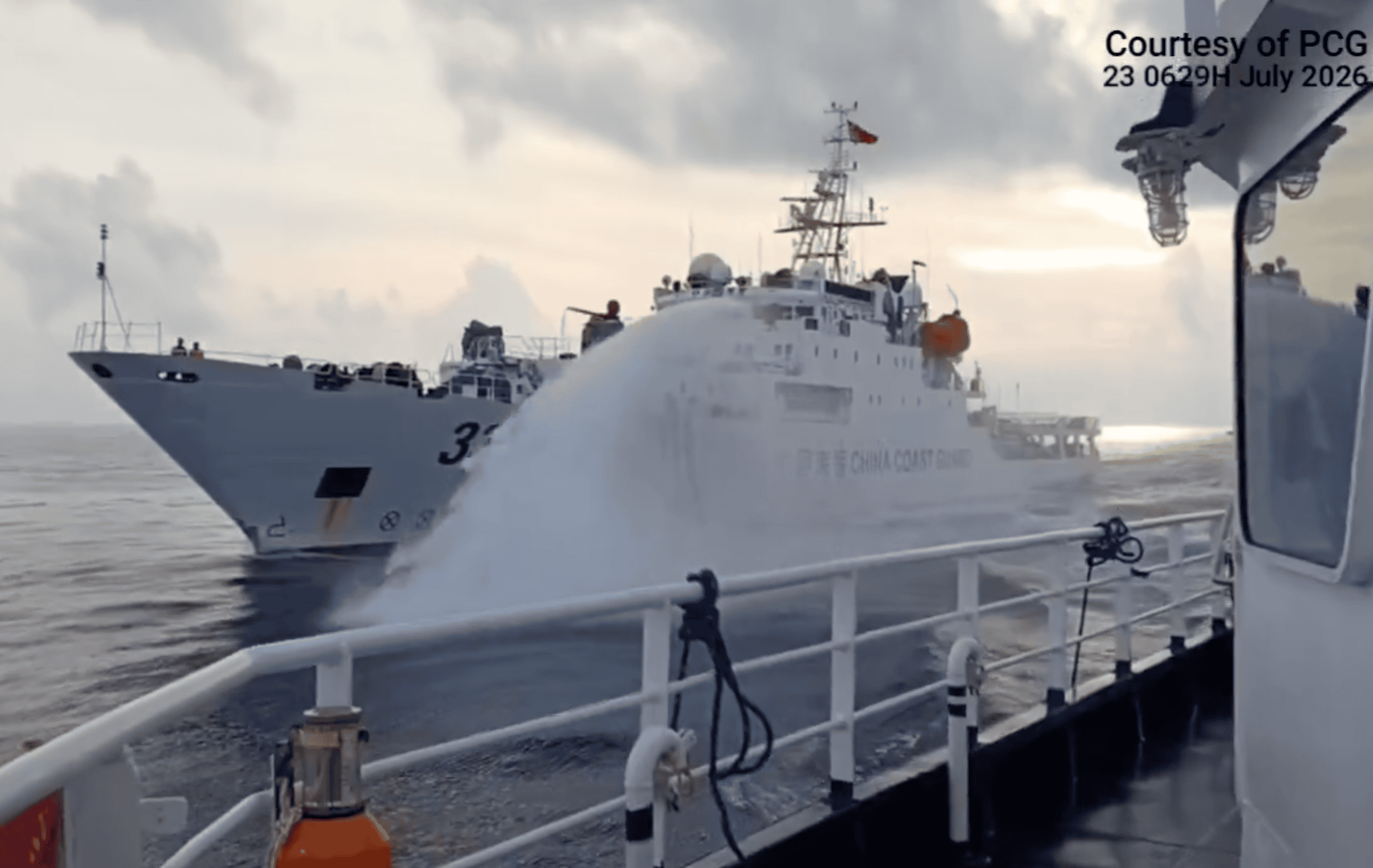
Early on Thursday morning, a China Coast Guard cutter trained its water cannon on a Philippine fisheries boat delivering fuel subsidies to fishermen at Scarborough Shoal in the South China Sea. The target, BRP Datu Dumangsil, was part of a subsidy run and Philippine Coast Guard spokesman Jay Tarriela said the cutter had first closed to “merely 50 meters off the bow” before firing. “These actions violated the international regulations for preventing collisions at sea and endangered Filipino personnel engaged in a purely humanitarian undertaking,” he wrote on X. China’s coast guard said it had lawfully blocked an infringing Philippine vessel. The same hours saw a Chinese fisheries survey wrap up east of Taiwan and a live-fire zone open in the Taiwan Strait. These were not three coincidences.
The Instrument Is the Fishery
Scarborough Shoal, the confrontation was over a fuel-and-food distribution to fishing boats; the Chinese assets arrayed against it, per Tarriela’s account, numbered nine coast guard vessels and a maritime militia ship, with a Philippine surveillance flight logging a People’s Liberation Army Navy vessel in support and drawing a radio challenge well inside the Philippine exclusive economic zone. Off Taiwan the same Thursday, Beijing’s Ministry of Agriculture and Rural Affairs concluded a week-long fisheries resource survey in waters east of the island that it said laid a foundation for understanding conditions in areas “under China’s jurisdiction,” and the PLA opened a two-day live-fire drill off Dongshan Island in Fujian.
The through-line is the assertion of routine administrative control — fisheries management, law enforcement, resource surveys — over water that international law assigns to someone else. A water cannon fired at a subsidy boat and a survey ship charting a rival’s waters are the same move in different registers: both manufacture a record of China governing the sea.
Scarborough Is Where the Method Was Perfected
That Scarborough Shoal is now the sharpest flashpoint is indicative. Through 2024 the pressure fell on Second Thomas Shoal; in 2025 it shifted to Scarborough, where CSIS’s China Power Project found the coast guard more than doubled its presence year on year. Thursday’s incident is the continuation of a campaign, not a departure from calm.
The legal provocation is pointed. The 2016 arbitral tribunal — the award Beijing calls null and void — specifically found that Filipino fishermen hold traditional fishing rights in the waters around Scarborough, and in the years after the ruling China had, by one detailed accounting, restored that access “in principle.” Firing a water cannon at a Philippine boat resupplying those very fishermen is not incidental to the award; it is a reversal of the one accommodation Beijing had made to it. China invokes UNCLOS against Japan at Okinotorishima while erasing, at Scarborough, the fishing right that same convention’s tribunal upheld. The law is deployed where it enlarges the claim and discarded where it constrains it.
A Ratchet Across Three Seas
The temptation is to read Thursday as an escalation. The wider data are not clear on that. What rises is reach and precedent: a coast guard helicopter in Japanese airspace, a carrier beyond the Second Island Chain, and now a single week in which China pressed jurisdictional claims against the Philippines, Japan and Taiwan almost simultaneously.
Fairness requires noting the limits. The Taiwan Strait drills were nearshore, confined to zones within 12 kilometres of the mainland coast, and SCMP notes PLA exercises “usually peak in mid and late July” for hot-weather training — this one may be as much seasonal routine as signal. No injuries were reported at Scarborough, and both Philippine vessels completed their mission. Individually, each event is calibrated and sub-threshold. That is precisely the design: coercion assembled from acts too small to answer with force, each absorbed into a new baseline from which the next begins.
The Timing Belongs to the Method, Not to Iran
The confrontation unfolded as Secretary of State Marco Rubio met Chinese Foreign Minister Wang Yi at the ASEAN gathering in Manila, where the Iran war loomed over the agenda, and as Philippine and Chinese foreign ministers traded protests over the encounter. Whether Beijing timed the water cannon to the diplomacy, or to Washington’s preoccupation with the Gulf, cannot be established from the public record.
The structural reading needs no such claim. A strategy built on incremental, administrative encroachment does not wait for opportune moments; it runs continuously, which is what makes it hard to answer. For Manila, Tokyo and Taipei, the lesson of one week in three seas is that the contest will not arrive as a war to be deterred. It arrives as a fishery subsidy met with a water cannon, a survey ship in waters claimed by someone else, a drill that is only ever called routine — and the question is whether they can make each of those small acts more expensive before it hardens into the map.
