
US strikes on Iranian tankers put law in focus
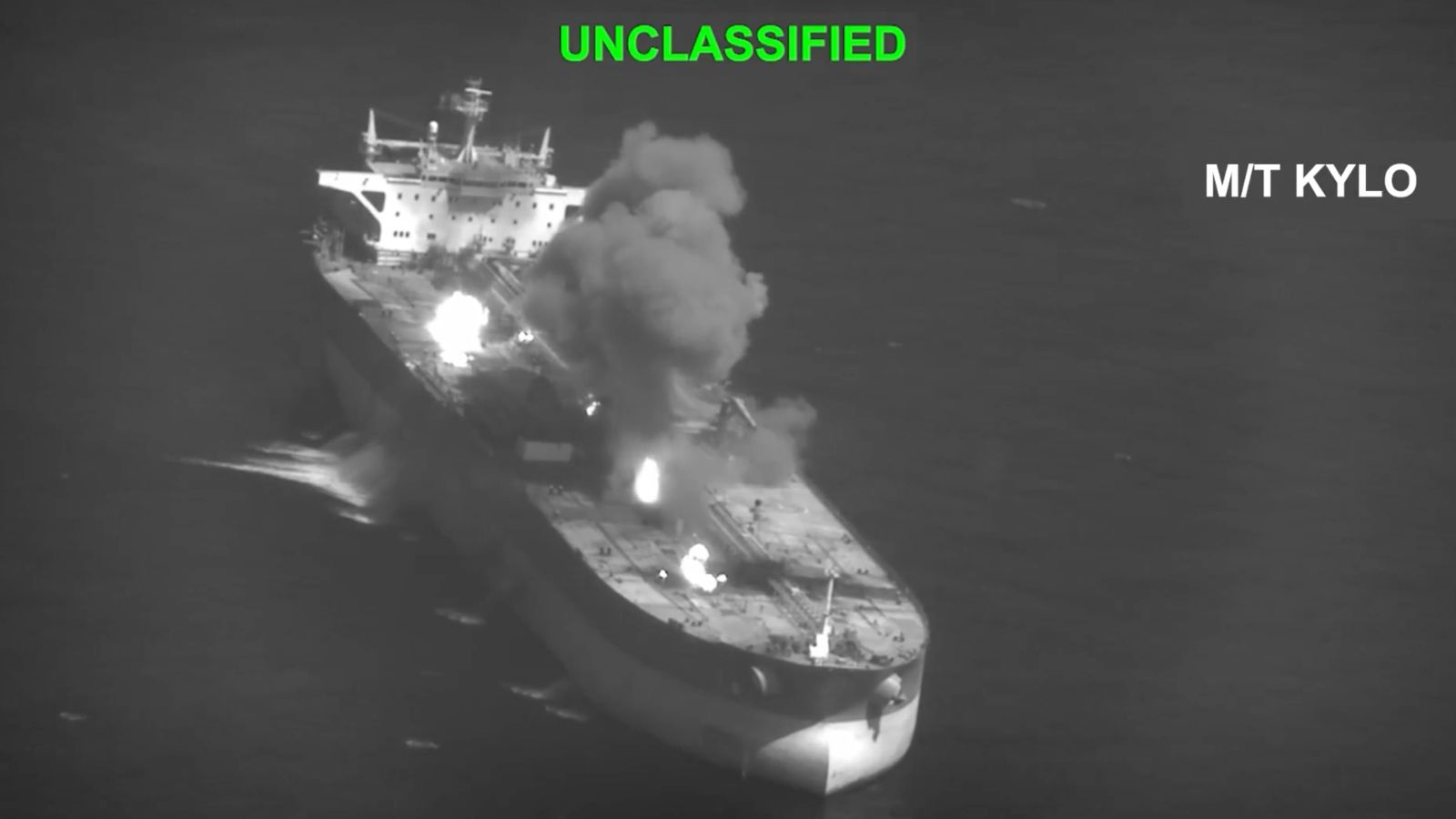
US Central Command said its forces struck three Iranian crude oil tankers on Saturday 5 September, disabling the M/T Downy off Kharg Island and the M/T Stark 1 near Jask, and destroying the unladen M/T Kylo in the Gulf of Oman. It said the strikes followed ballistic missiles fired by the Islamic Revolutionary Guard Corps (IRGC) at a US aircraft carrier and a guided-missile destroyer. No American personnel were hurt.
The military facts are largely agreed. The legal basis is not. CENTCOM’s stated reason for hitting oil tankers, rather than the units that fired the missiles, was to impose a cost on Iran’s economy. That reasoning sits at the contested edge of the law of naval warfare, and it rests on a body of American maritime enforcement practice that specialists have been taking apart since April.
What Washington says
Admiral Brad Cooper, the CENTCOM commander, said that if Iran fired at two American ships, the United States would “impose an even higher economic cost” by taking out three Iranian ones. He added that US forces would destroy Iran’s oil fleet if that became necessary. US defence secretary Pete Hegseth wrote on X that Washington would sink Iranian tankers whenever Iran fired on American ships.
As deterrence, the position is coherent. As law, retaliation is not a category. A vessel is either a lawful target at the moment it is struck or it is not, and what a different Iranian unit did earlier that day does not change the answer.
The targeting test
Michael Schmitt of the University of Reading and Rob McLaughlin of the University of Wollongong set out the rules for Just Security in March, in a piece updated in August. Iranian-flagged merchant ships are enemy vessels and can be captured on sight anywhere outside neutral waters. Attacking them is a separate question. They may be attacked only if they qualify as military objectives, by carrying troops or military supplies, acting as naval auxiliaries, resisting visit and search, or sailing under enemy escort. Attack is available “only if capture is not possible”.
Whether an export tanker qualifies turns on the phrase “military objective”. Schmitt and McLaughlin describe two readings. On the traditional one, which they endorse, commercial exports do not become military objectives merely because they earn a government money. On the “war-sustaining” reading, for which they name the United States as the primary proponent, objects funding an enemy’s capacity to keep fighting can be attacked. Cooper’s economic-cost formula is the second reading, stated without adornment.
What the blockade notice actually says
CENTCOM’s own paperwork is narrower than its rhetoric. The blockade declared on 13 April, published to shipping as a Joint Maritime Information Center advisory through UK Maritime Trade Operations, is confined to the Gulf of Oman and Arabian Sea east of the Strait of Hormuz. An update on 16 April lists contraband liable to capture and classes crude oil as conditional contraband, citing its role in military operations and its contribution to what the notice calls Iran’s “war-sustaining economy”.
Two details in that document matter on Saturday’s facts. The notice makes contraband status depend on cargo being destined for Iranian territory. Iranian crude loading at Kharg travels the other way. And Kharg lies in the northern Persian Gulf, outside the declared blockade area.
CENTCOM did not present the strikes as blockade enforcement, and on the face of its own notice it could not have. The justification rests on targeting law alone.
Not one blockade, but five
Mark Nevitt, a retired US Navy JAG commander now teaching at Emory University School of Law, argued in Just Security in May that the conflict contains five distinct blockade-style operations, collapsed into a single label that obscures the authority for each.
His findings do not run in one direction. Iran’s closure of the Strait of Hormuz on 2 March, its mining of the waterway and its firing on neutral shipping are all unlawful, he writes. The American blockade of Iranian ports, by contrast, meets the traditional requirements: publicly declared, applied to all flags without distinction, geographically bounded, effective, with humanitarian cargo and neutral transit preserved. That operation stands on firm ground.
The difficulty is at the edges. The 16 April update asserts a worldwide belligerent right to board any vessel carrying an active US Treasury sanction. Nevitt argues that has no basis in the law of naval warfare, because a domestic administrative designation is a law-enforcement instrument and no naval warfare manual treats it as a wartime one. Both tankers CENTCOM named off Kharg and Jask carry Treasury designations, listed in the Federal Register as linked to the National Iranian Tanker Company rather than to the IRGC.
Neither war nor peace
Beneath the doctrine is a question of legitimacy. The United States is exercising belligerent rights at sea while declining to call the situation a war. Vice-President JD Vance said last week there was “no active shooting”. A memorandum of understanding signed in mid-June was followed by the collapse of talks and a resumption of strikes, according to the Associated Press. Nevitt’s characterisation of the American position is that it is neither fully at war nor fully at peace.
Iran’s foreign ministry, in a statement carried by IRNA, said the strikes “constitute a war crime” and breached Article 2(4) of the UN Charter. As a legal finding that is unproven, and it comes from a party to the conflict. As a description of the ambiguity, it points at something Washington has not addressed.
Nevitt’s warning is about what outlasts the war. If the United States establishes by practice that sanctions designations authorise boarding anywhere at sea, and that export revenue makes a merchant ship a target, it will have rewritten the law of the sea without agreeing it with anyone. Those rules would then be available to every other navy.
