
U.S. Responds as China’s Coastguard Clashes With Treaty Ally
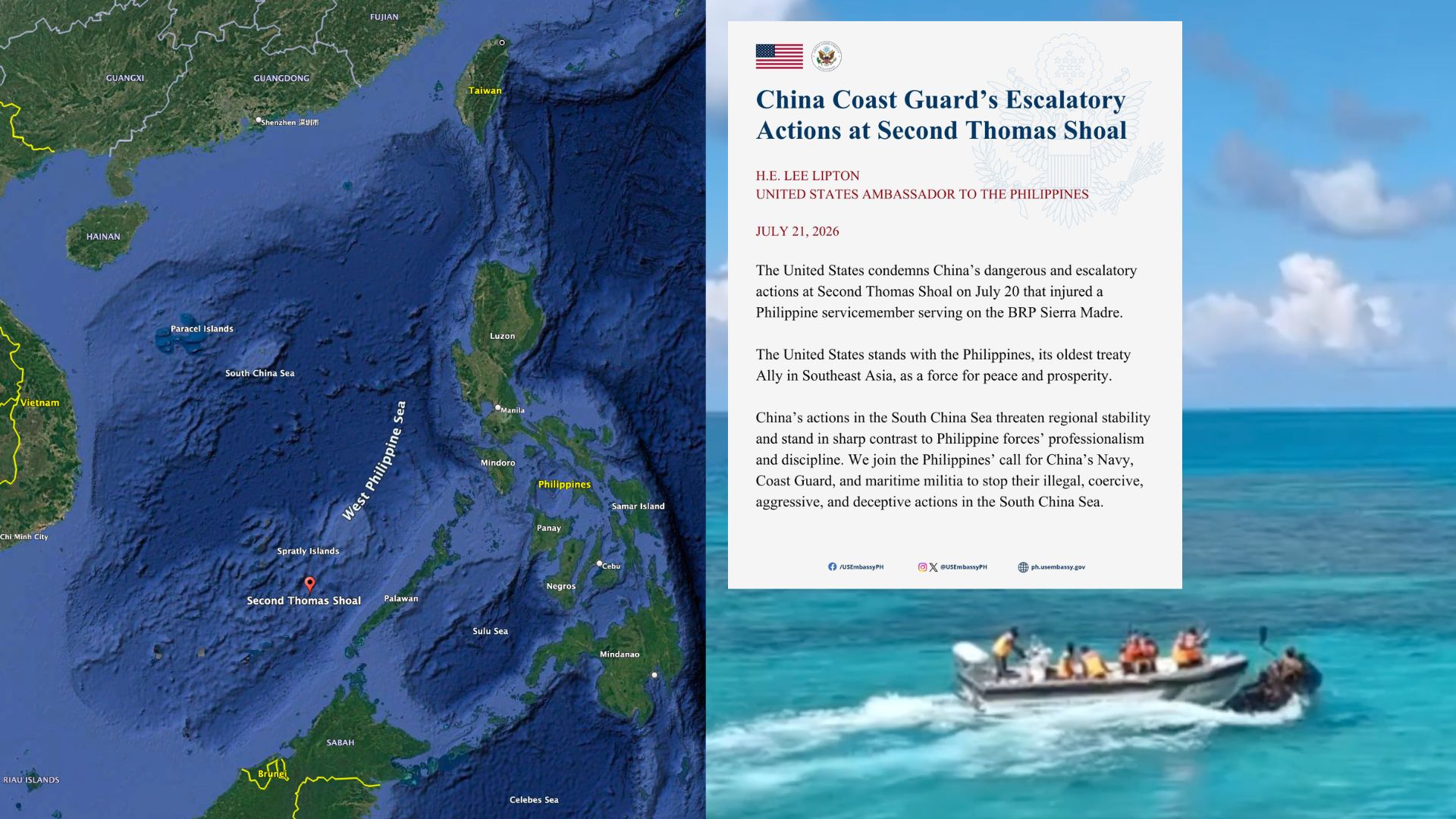
The weapon was a wooden baton on a remote shoal in a tropical sea. It was a chaotic confrontation between small boats with global implications.
The United States Ambassador to the Philippines, Lee Lipton, condemned “China’s dangerous and escalatory actions at Second Thomas Shoal on July 20 that injured a Philippine servicemember serving on the BRP Sierra Madre,” and affirmed that Washington “stands with the Philippines, its oldest treaty Ally in Southeast Asia.” A Filipino sailor was struck on the head and left with an open wound aboard in the fracas with the Chinese coastguard members — as the Filipinos wielded paddles from their boat. The American statement was unusually forthright and that can only have been by design of both Washington and Manila in the face of a growing confrontation.
China’s embassy in Manila hit back, saying: “The U.S. is not a party to the South China Sea issue, yet it tries every means to stir up tension in the South China Sea, sowing discord and fanning the flames in the region, thereby undermining the joint efforts of regional countries to manage maritime differences. We urge the U.S. side to immediately stop maliciously smearing and criticizing China’s legitimate and lawful rights-protection and law-enforcement actions.”
The Legal Grounding is Firm
The legal ground here is firm except from a Chinese perspective. Second Thomas Shoal is a low-tide elevation roughly 104 nautical miles from the Philippine archipelagic baseline near Palawan and 616 nautical miles from the nearest Chinese-claimed baseline point at Hainan. The 2016 Arbitral Tribunal found that the shoal sits within the Philippine exclusive economic zone, that it is incapable of appropriation by any state, and that China’s dashed-line claims are contrary to UNCLOS and without lawful effect. The BRP Sierra Madre, grounded there in 1999, remains a commissioned Philippine Navy vessel entitled to sovereign immunity.
Washington’s declaratory policy is equally firm. US Indo-Pacific Command’s own legal guidance states that an armed attack on Philippine “armed forces, public vessels, or aircraft, including those of the Coast Guard in the South China Sea, would invoke U.S. mutual defense commitments under Article IV.” The same document then opens a door that is rarely discussed: what constitutes an armed attack under the treaty is not defined, and an illegal use of force “is not limited by law to a kinetic armed attack” but “could also include non-kinetic attacks that result in death, injury, damage, or destruction of persons or objects.”
A Campaign Engineered to Stay Below the Line
Beijing has read that document too, or has arrived at the same conclusion empirically. The pattern at the shoal is one of escalating physical harm delivered by conspicuously non-military means. According to the Armed Forces of the Philippines, China Coast Guard cutter 21560 approached Sierra Madre at 9:15 a.m. on July 20 and launched a small boat crewed by eight, which circled the outpost; two Philippine rigid inflatables moved to escort it away, and the Chinese crew struck a sailor with a wooden baton. Video released by the AFP shows the Chinese boat ramming the smaller Philippine craft. Chinese video shows the Philippine sailors wielding paddles.
Water cannon, lasers, ramming, acoustic devices, batons: the escalation ladder has been climbed rung by rung, and not one rung involves a fired weapon. China’s account inverts the sequence entirely, describing a routine patrol whose officers faced “malicious attacks” with “oars, long poles, and other tools” and who responded with “verbal warnings, evasive maneuvering, and proportionate countermeasures” while exercising “the utmost rationality and restraint.” Philippine Coast Guard spokesperson Jay Tarriela rejected the framing sharply: “Calling that a ‘provocation’ is like a burglar accusing the homeowner of harassment.”
The competing statements matter less as truth claims than as evidence of method. Coercion conducted by a coast guard rather than a navy, with hand tools rather than ordnance, is designed to accumulate strategic effect while never presenting Washington with a moment it must treat as an armed attack.
Why This Line, Not Taiwan, Is the One Currently Under Fire
Taiwan attracts the forecasting, the wargames and the budget justifications. But Taiwan is deterrence in waiting. The West Philippine Sea is deterrence in contact — the only place where Chinese state forces routinely injure the uniformed personnel of a United States treaty ally, and where the injuries are photographed, dated and published within hours.
The alliance response has been material and not only declaratory: nine EDCA sites, the Typhon mid-range capability and NMESIS deployed from 2025, and a bilateral commitment to increase deployments of US missile and unmanned systems.
The Iran War Is the Variable Beijing Is Measuring
The timing is not incidental. The clash came as Manila hosted the 59th ASEAN Foreign Ministers’ Meeting, with Marco Rubio and Wang Yi both in the city — and with the US-Iran war, not the South China Sea, dominating the agenda. Southeast Asian ministers planned a joint statement expressing alarm at the Middle East hostilities that have disrupted the Strait of Hormuz and forced President Marcos to declare a national energy emergency in March.
There is no evidence in the public record that Beijing timed the July 20 encounter to exploit American distraction, and it would be irresponsible to assert one. But the structural point stands independent of intent: a coercion campaign built on sub-threshold force is most productive precisely when the guarantor’s attention, munitions and carrier decks are committed elsewhere. Interceptor stockpiles consumed over the Gulf are not available for the Philippines.
The likely trajectory is continuity, not rupture. The shoal will keep producing casualties measured in wounds rather than deaths. But the risk of a bigger confrontation is very real. China will keep calibrating to test the U.S. line. The United States knows this remote shoal could be as big a flashpoint as any other global hotspot.
Updated on 07/21/2026 at 2:08 a.m. ET with Chinese embassy comment
