
The Houthis Are Coming And That’s A Bad Sign For Iran
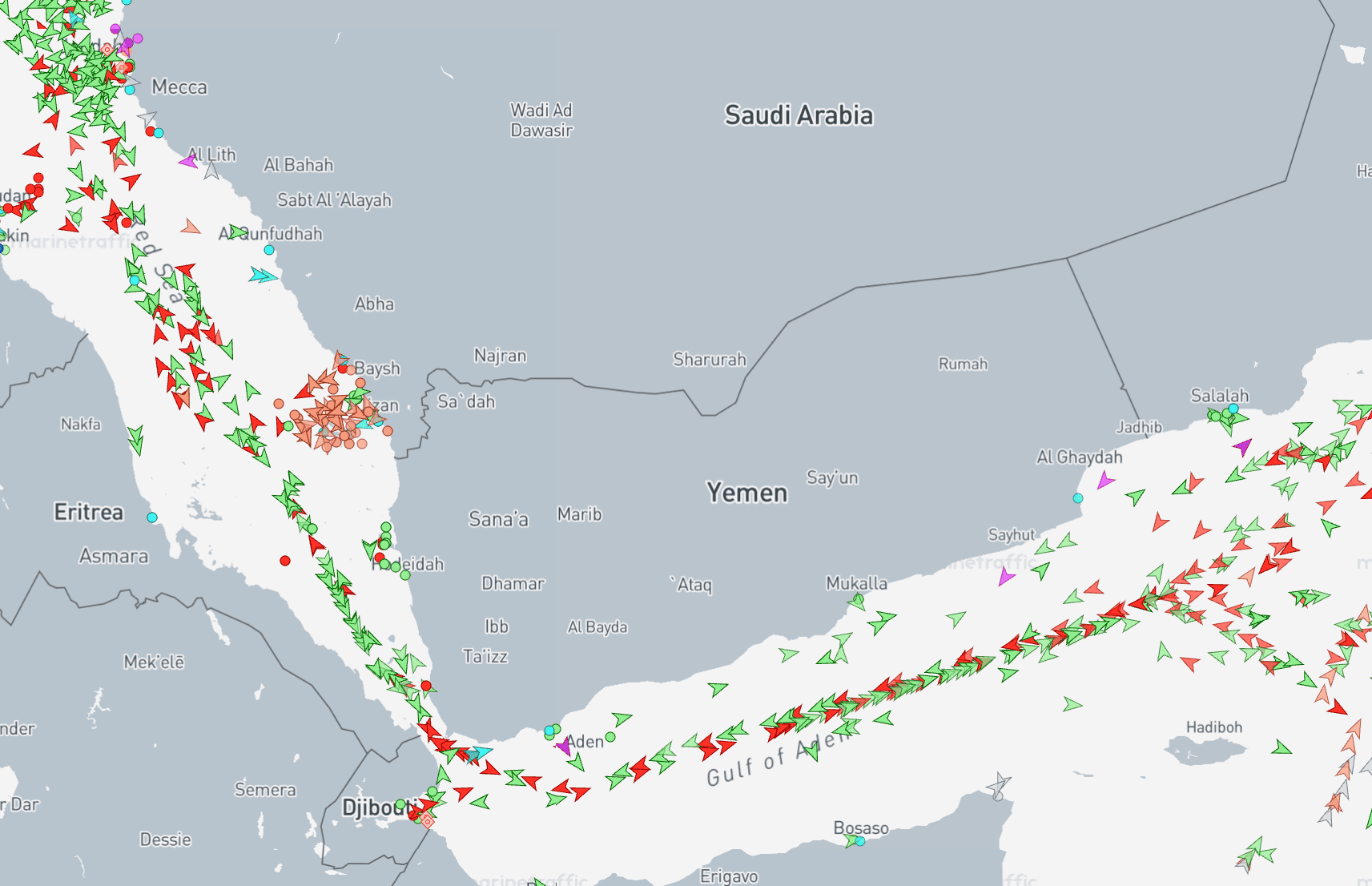
Iran has had to bring in the Houthi option as it comes under pressure from U.S. strikes over control of the Strait of Hormuz. Announcing a maritime ban on Saudi Arabia on Monday, Houthi military spokesman Yahya Saree framed the measure as “Blockade for Blockade” and said his movement affirmed “our people’s right to confront the blockade with a blockade, and comprehensive escalation with comprehensive escalation.” He accused Riyadh of an “unjust siege” lasting nearly 12 years, and the group specified neither the ban’s geographic scope nor its mechanics. He did not even mention Iran, but it is the Houthis’ backer that is the hidden hand here. There has been no obvious impact on shipping yet, as the MarineTraffic map shows, but it is early to tell.
Saudi Arabia’s Hormuz Bypass Worked, And Relocated The Target
When Israel and the United States attacked Iran on February 28, Tehran’s partial blockade of the Strait of Hormuz disrupted most Gulf oil exports and delivered a global energy shock. Riyadh had spent decades preparing for exactly this. It activated its contingency plan within hours of the first strikes, pushing crude through the East-West pipeline — more than 1,000 kilometers across the Arabian Peninsula, itself a by-product of the 1980s Iran-Iraq tanker war — to the Red Sea port of Yanbu. By late March the line was running at its full capacity of 7 million barrels a day, with Yanbu crude exports reaching about 5 million barrels daily.
The scale of the shift is vital. Saudi Arabia has diverted more than 70 percent of its normal daily crude exports to Yanbu, where shipments have averaged 4 million barrels a day in recent weeks against roughly 973,000 barrels in the same period last year. Total petroleum moving through Bab el-Mandeb reached 7.4 million barrels a day in June, about 7 percent of global oil output, up from 4.2 million a year earlier.
That bypass has been a genuine achievement, and it is one reason oil prices have not reached the crisis highs of earlier supply shocks. It is also why a Houthi announcement that would have been close to meaningless in January is a market event in July. Riyadh did not eliminate its chokepoint exposure. It moved that exposure from a strait Iran commands to a strait the Houthis overlook — and it did so under duress, at speed, with no third option available.
The 2023 Precedent Points The Opposite Way From The Comfortable Reading
The instinct among analysts who lived through the last Red Sea campaign is to discount this one. The Houthis attacked shipping from November 2023, prompting Maersk, Hapag-Lloyd and others to divert around Africa, and a US-led mission shot down hundreds of drones and missiles; the attacks tapered and ended with the Gaza ceasefire in October. Carriers had begun resuming some Red Sea routes. In June the group said it would ban Israel-linked ships from the Red Sea, and never acted on it.
But the earlier campaign is a poor guide: when the Houthis began attacking Red Sea shipping in November 2023, Gulf oil exports were flowing freely, so cargoes were not halted. This time they are being loaded there. In 2023 the Red Sea was a convenience that container lines could abandon for a longer voyage. In 2026 it is where a substantial share of Saudi crude physically enters the world market. Rerouting is not available to a barrel that has already crossed the peninsula by pipe.
Iran Shaped The Battlefield; The Houthis Chose The Moment
Iranian alignment is documented and unsubtle. Tehran champions the Houthis within its “Axis of Resistance,” and has said that they could choke off the Red Sea. A Houthi politburo member, Mohammad al-Farah, warned on Iran’s Press TV website that continued escalation would see Bab el-Mandeb closed. Washington says Iran has armed, funded and trained the movement with Hezbollah’s help.
The Houthis deny being an Iranian proxy and they also have domestic concerns, but they are ultimately beholden to Tehran. Through the first four months of this war they were conspicuously quiet while Hezbollah and Iraqi groups engaged early — plausibly holding the Red Sea card in reserve, or protecting their own truce with Riyadh.
The trigger, when it came, was local and contested. Yemen’s internationally recognized government said on July 13 that it struck the Sanaa airport runway to stop an Iranian aircraft landing, stating that the Houthis had “insisted that the Iranian aircraft violate Yemeni airspace.” The Houthis blamed Saudi Arabia without providing evidence, there was no immediate comment from Saudi authorities, and Saree warned that “this aggression will not go unanswered or unpunished.” Missiles followed at Abha, ending a truce that had largely held since 2022. Iran is present at every stage of that sequence — as the object of the dispute, as patron, as the party whose war shut Hormuz in the first place.
A Weapon Whose Value Depends On Restraint
The Houthi leader Abdul Malik al-Houthi said on March 5 that “our fingers are on the trigger at any moment should developments warrant it.” Monday’s announcement is best read in that spirit: a declaration calibrated to be maximally alarming and minimally committal. Naming no coordinates and no enforcement method leaves every underwriter in London to price the whole Red Sea, which is cheaper than sinking anything and harder to retaliate against.
Riyadh’s options are correspondingly poor. It is considering an expansion of the pipeline to the Red Sea coast, which would deepen rather than diversify the dependency. The Yanbu route only partly offsets the loss of Hormuz, through which some 15 million barrels a day of crude passed before the war; there is no third corridor waiting.
If the pattern of this war holds, the ban will function as leverage rather than interdiction — an announced capability that extracts concessions precisely because using it would invite the US-led naval response the Houthis absorbed in 2024. The rising oil price is already going to be a worrying signal for Washington and if any attack happens, it may also strike the Houthis again. But it could also serve American interests of forging a more effective alignment of pro and anti-Iran forces.
