
Gulf drone defences improve too slowly to deny Iran bargaining power
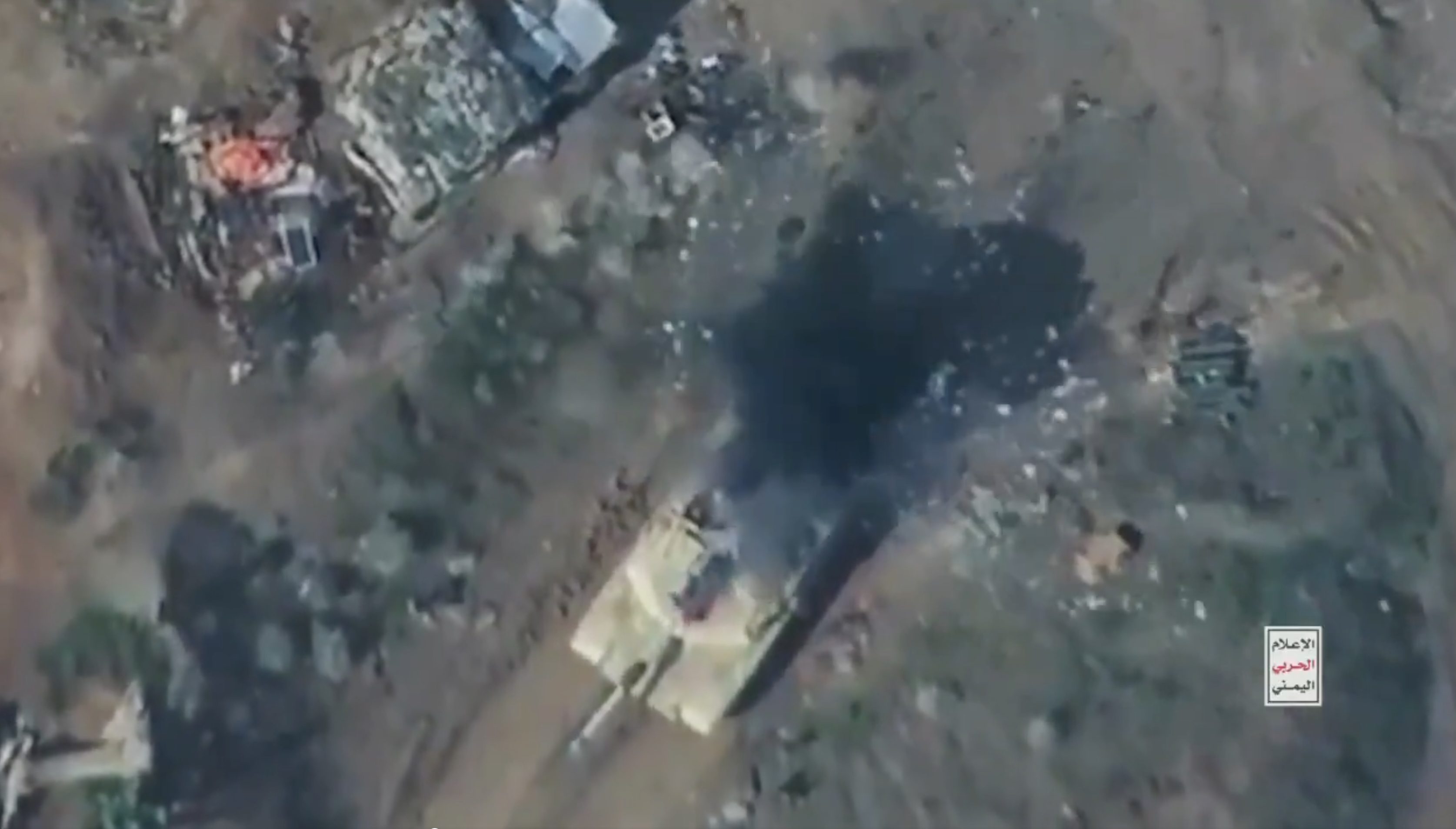
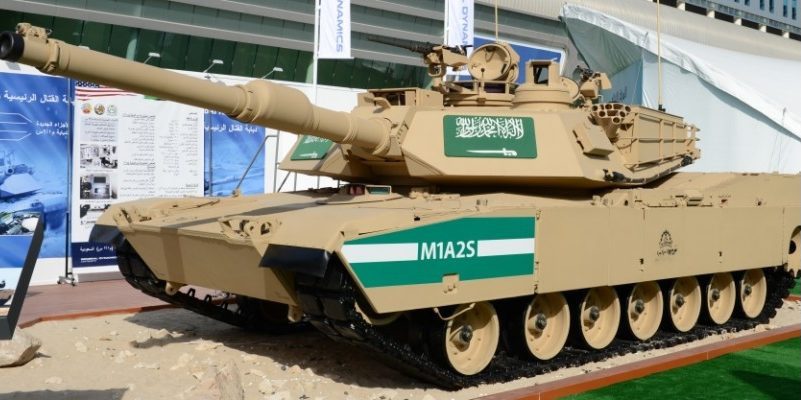
On 21 August the Houthis released a 10-minute compilation of drone strikes on Saudi-backed forces in Marib and along Yemen’s west coast. One sequence, circulated widely by the open-source account OSINTtechnical, shows a munition dropped onto the turret of an M1A2S Abrams tank, followed by an ammunition explosion; the account noted that both rear blowout panels appeared to activate.
South Front reported the Houthis attributed the strikes to the Rujum, a bomber drone the group says is based on the Chinese-made YD6-1000S hexacopter, with a 44-minute endurance and a two-kilogram payload, modified mainly to carry 60mm mortar rounds. Defence Blog described the platform as a quadcopter. Either way, a commercial airframe and an infantry mortar round appear to have destroyed a Western main battle tank belonging to a state that has been fighting this same adversary for 11 years.
The layer that was never built
That is just a part of the Gulf’s air defence problem. Writing for the Arab Gulf States Institute in Washington in April, Francesco Salesio Schiavi identified three structural constraints exposed by the Iranian campaign: the economics of interception, magazine depth, and replenishment. Gulf architectures were built over three decades around ballistic missiles. The Center for Strategic and International Studies (CSIS) put it flatly in an April report: Patriot, Terminal High Altitude Area Defense (THAAD) and Standard Missile interceptors “are not suitable for defense against drones because of their high cost and scarcity”.
CSIS also recorded what happened when that architecture met a mass drone attack. US forces largely avoided firing high-end interceptors at cheap drones, but the Gulf states may have done so in the war’s opening days; both then improvised, using helicopters with guns, fixed-wing aircraft with guns, and air-to-air missiles. Some of those, CSIS noted, are AIM-120s costing about $1.03m each.
The consumption figures follow from that. CSIS assessed on 27 July that US Patriot inventories had fallen below 1,000 interceptors and THAAD to about 250, against a pre-war THAAD holding it at 452. Defense News, reading the same analysis, reported drawdowns of roughly 65% and 38%. CNN reported, citing two people familiar with an inventory report, that nearly four-fifths of THAAD stocks had gone; Defence Secretary Pete Hegseth publicly rejected that figure. For the Gulf states themselves, Schiavi cited an estimate by the Jewish Institute for National Security of America that the UAE and Bahrain — which between them absorbed around 44% of Iranian attacks — had expended more than three-quarters of their Patriot PAC-3 stocks.
Depletion became a constraint on Washington
This is where preparedness turns into a negotiating position. In late July the New York Times reported that President Donald Trump shelved plans to expand the campaign against Iran, and that concerns over interceptor stocks were central to the deliberations. Joint Chiefs chairman General Dan Caine privately advised that major combat operations were feasible but would exhaust the interceptors available to US Central Command. White House communications director Steven Cheung told the Times that Trump “prefers a diplomatic solution” while retaining his options.
Tehran does not need to win an interception exchange to profit from that. It needs Washington’s escalation options to carry a defensive cost that the Gulf states are unwilling to absorb. Reuters reported on 5 August, citing a senior Iranian official, a senior regional diplomat and Gulf sources, that Iran had warned Gulf governments through Riyadh and Doha that it would strike their energy facilities, electricity grids, water infrastructure and transport networks if the United States hit Iranian infrastructure. Reuters reported that Mohammed bin Salman subsequently urged Trump to delay military action and return to talks. The mechanism is straightforward: an unprotected host nation is a brake on its guarantor.
The 60-day negotiating window created by the Islamabad Memorandum of Understanding expired on 17 August without extension, and Trump said on 19 August that talks were paused. The Gulf’s defensive shortfall is one of the few Iranian assets that has not been degraded in the interim.
What the Gulf is buying, and when it can arrive
Procurement has moved unusually fast by regional standards. Schiavi reported that two South Korean Cheongung-II batteries were in Emirati service by mid-March, with a reported intercept rate of 90–96% — though he cautioned this reflected a layered network firing roughly 60 interceptors at about 30 targets, not a standalone system. Each costs about a third of a Patriot missile. Saudi Arabia has pressed for earlier delivery of its own 2024 order.
The more relevant purchases are cheaper still. Ukraine signed defence agreements with Saudi Arabia, the UAE and Qatar and offered interceptor drones at $800–$3,000 per unit; President Volodymyr Zelensky said Kyiv could supply up to 1,000 a day. By mid-March, 201 Ukrainian specialists were deployed across the three states, transferring not hardware but method — how to assign cheap threats to cheap responses and preserve expensive interceptors for what needs them. Britain moved its Sky Sabre system to Saudi Arabia and contracted the start-up Cambridge Aerospace to supply Gulf partners with interceptors built specifically against Shahed-type drones. On 7 August, Saudi Arabia, Turkey and Pakistan signed the Mecca Joint Defence Agreement, treating an attack on one as an attack on all, and opening Riyadh’s access to Turkish counter-drone industry.
Against that, delivery timelines. CSIS put the manufacturing cycle for high-end interceptors at roughly 52 months, and Schiavi’s observation is that American willingness to sell has not translated into speed. Nothing in the pipeline changes the picture before 2027.
Where Tehran’s advantage runs out
The case that Iran’s position erodes with time is strong. CSIS found Iran fired more than 2,000 drones and 500 ballistic missiles in the first four days of the war, with launches down 83% and 90% respectively within a week. Farzin Nadimi of the Washington Institute counted about 4,400 one-way attack drones fired by Iran and its proxies before the 7 April ceasefire, 85–90% of them in the first two to three weeks, with roughly 90% intercepted. CSIS noted on 27 July that Iranian launch rates since the resumption of fighting have run below pre-ceasefire levels.
But Nadimi’s assessment is also that Iran responded to losing its airspace by converting the campaign into attrition: smaller waves, dispersed and concealed launches, greater use of Iraqi proxies, and selective targeting of radars, hangars and logistics nodes where a handful of penetrations produce disproportionate effects. He judges the drone enterprise easier to regenerate than the missile force, sustained by universities, workshops and dual-use suppliers. Damage assessments conflict sharply: US military estimates cited by Nadimi put 85% of the arsenal and industrial base as damaged or destroyed, while Reuters reported in late March that US intelligence could confirm only about a third.
Gulf hardware arrives over years. Iran can regenerate drone capacity in months. Doctrine — the Ukrainian contribution — changes in weeks, and is the part genuinely eroding Tehran’s leverage.
Point defence for deployed ground forces against a modified hobby airframe is the cheapest problem on the list, and Saudi Arabia has had 11 years of the same war in which to solve it. That it apparently has not is the more troubling indicator.
