
Southeast Asia divided in U.S.-China tech war
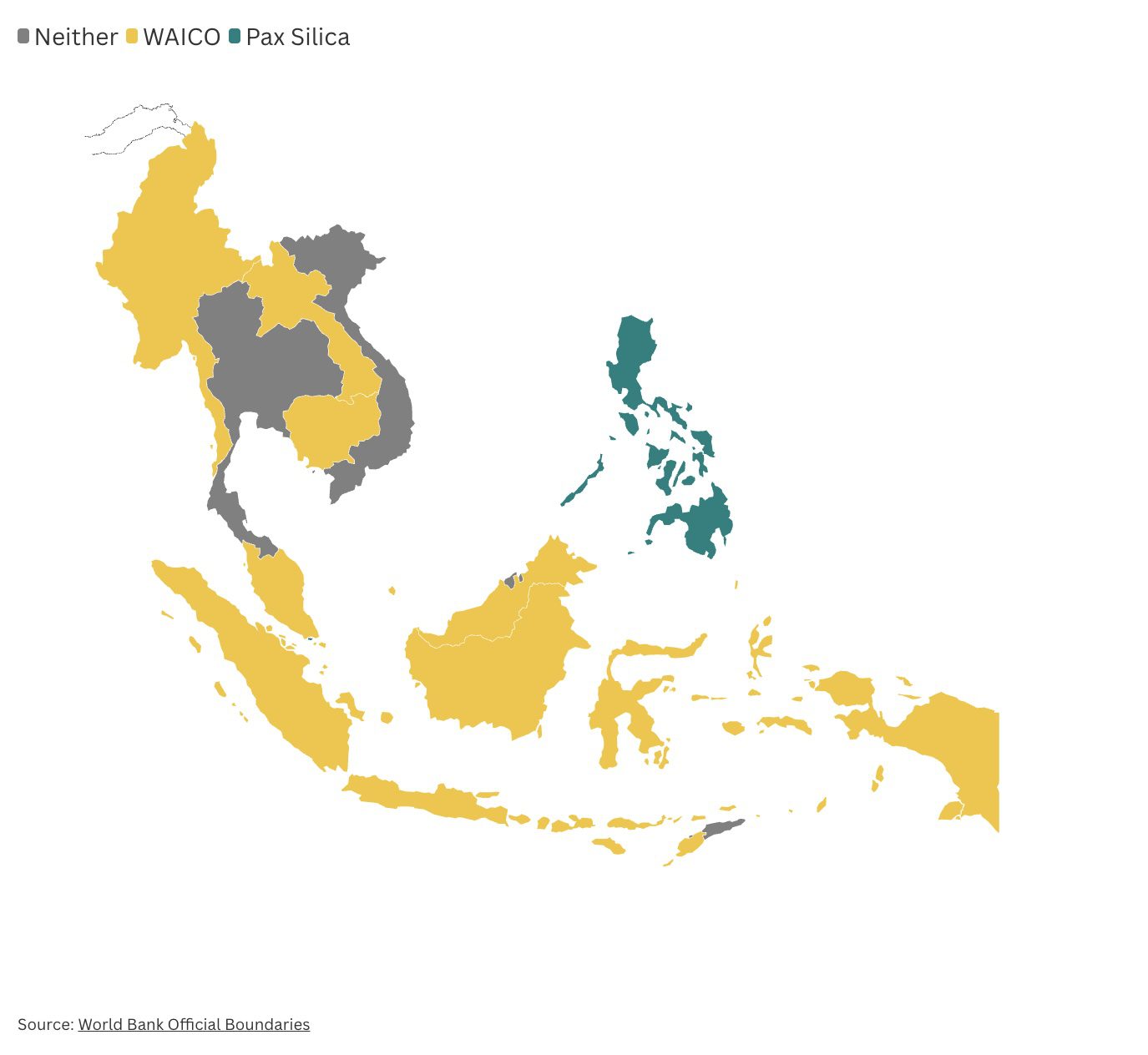
Southeast Asian bloc ASEAN can only act together when its members agree, and on the question now being put to them they no longer do. Five of the eleven members joined the Chinese-led World Artificial Intelligence Cooperation Organization (WAICO) at its founding in Shanghai on 16 July: Cambodia, Indonesia, Laos, Malaysia and Myanmar. Two — Singapore and the Philippines — are on the US State Department’s list of signatories to its AI Opportunity Statement. None has signed both. In August the department drafted a letter, reported by Reuters on 14 August and still unsent, telling the 35 signatories of that statement that membership cannot be held alongside initiatives whose expectations conflict with Washington’s.
Seven members have already declared a preference, in public, in writing, before any collective regional discussion of what the two frameworks are worth or what they might jointly be used to extract.
What acting as a bloc would require
ASEAN’s method is consensus. It has no majority voting, no mechanism to bind a dissenting member, and no capacity to negotiate externally on behalf of members who have not agreed to the mandate. That method has held for decades because it was rarely tested on questions where members’ interests pointed in genuinely opposite directions; where they did — the South China Sea being the standing example — the bloc has produced silence rather than a position.
For ASEAN to bargain collectively here it would need three things: a shared assessment of what Pax Silica and WAICO membership is worth, a common list of terms to demand in exchange, and members willing to withhold individual signatures until those terms were met. The third is the operative one, and it is now unavailable. Seven members have already signed. Whatever leverage a coordinated regional abstention might have carried was spent in the eight months between December 2025 and July 2026, member by member, in two capitals thousands of miles from any ASEAN meeting room.
This is the answer to the “can” half of the question, and it is arithmetic rather than judgement. A consensus body cannot form a common external position from members who have publicly committed in opposite directions on the very issue at hand.
The pattern of unilateral action is accelerating
The “will” half is answered by behaviour. Members are not merely failing to coordinate; they are taking positions that make coordination harder, and doing it faster.
On 16 August, in an Al Jazeera interview, Malaysian Prime Minister Anwar Ibrahim said he saw “Taiwan as part of China, period”, and, asked whether he would condemn the use of force, drew an analogy with preserving Malaysia’s own territorial unity. Chinese foreign ministry spokesman Lin Jian said on 19 August that China appreciated the remarks. Taiwan’s foreign ministry said the one-sided support could damage Taiwanese businesses’ confidence in investing in Malaysia. Anwar said the next day that Malaysia’s one-China policy dated to Abdul Razak Hussein and was unchanged.
The following day, 17 August, Thai Prime Minister Anutin Charnvirakul said Thailand would remain neutral in the AI race and would not be pressured into choosing, and that security cooperation with the United States was unrelated to trade negotiations.
Two ASEAN heads of government, in the same week, taking materially different public positions on the central strategic question facing the region — one endorsing Beijing’s framing on Taiwan including on force, the other declining to align at all. Neither consulted the other. Neither was speaking for the bloc, and neither pretended to be. This is what the absence of a collective posture looks like in practice: not a failure to agree, but a settled habit of not attempting to.
The stakes are divergent enough to make agreement unaffordable
Even if the will existed, the underlying exposures do not permit a common line, because members would be asked to bear very different costs.
Malaysia’s trade with Taiwan rose 34.7 per cent year on year to 147.75 billion ringgit (US$36 billion) in the first half of 2026, according to the government agency Matrade — an exposure to a Taiwanese semiconductor relationship that Cambodia and Laos simply do not have, and which Anwar’s remarks have now placed in question.
The defence ledger diverges further still. Thailand, which has joined neither framework, closed the ninth “Falcon Strike” joint air exercise with China at Udorn on 20 August, according to China Military Online, the Chinese defence ministry’s outlet, while continuing to host Cobra Gold with the United States. Cambodia, a WAICO founding member, runs the Golden Dragon exercises with China — extended across land, sea and air including at the Chinese-financed Ream facilities, per the Khmer Times — while having agreed to revive the Angkor Sentinel exercise with Washington, suspended since 2017 and not yet held. The Philippines, inside the American AI framework, ran Balikatan 2026 with more than 17,000 US and Philippine personnel.
A regional position on AI alignment would require Manila to accept terms compatible with Phnom Penh’s Chinese basing relationship, and Phnom Penh to accept terms compatible with Manila’s treaty alliance. There is no such set of terms. The bloc’s members are not merely differently inclined; they are differently exposed, and a common position would ask some of them to pay for others’ preferences.
The one instrument that might have served
ASEAN does have a relevant vehicle. Negotiations on the Digital Economy Framework Agreement concluded in May, and signature is scheduled for the summit in November; it covers artificial intelligence, cross-border data flows and cybersecurity, and is the closest thing the region has to a common technology rulebook.
It will not do this job, for reasons of sequence rather than substance. Seven members committed to one framework or the other before the agreement is even signed, which means it cannot function as a precondition for those signatures. Signature is not ratification, and ratification will run through eleven domestic processes at eleven speeds. And a harmonised internal rulebook is not the same instrument as an external negotiating mandate; nothing in it authorises anyone to speak for the bloc opposite Washington or Beijing. DEFA will make it easier for ASEAN members to trade with each other. It will not make them able to bargain together against anyone.
What is actually at stake
The consequence is not that ASEAN fractures into two hostile halves. Neither framework requires that. Pax Silica is non-binding, and WAICO’s establishment agreement asks only that members pay an annual contribution set by its Council and permits withdrawal on a year’s written notice — pay a subscription, sit on a Council, leave when you like. Nothing in either text restricts what a member may buy, build or sign elsewhere.
The consequence is that individual members will negotiate individually, and will do so against counterparties who can see the whole board. A country of thirty million bargaining alone with Washington over chip access, or with Beijing over minerals processing, gets worse terms than eleven countries bargaining together — and gets them without the option of citing regional constraints it cannot invoke. The cost of not acting as a bloc is not dramatic. It is a slow, compounding discount applied to every deal each member signs from here.
What would show this hardening
Three things, in order of significance. Whether the American letter is sent with the exclusivity language intact, since that is the only mechanism currently proposed that would make membership cost anything. Whether any state is actually excluded for dual membership — Kazakhstan, in both coalitions, is the test case, and the outcome will price the choice for every ASEAN government watching. And whether AI alignment starts appearing in defence arrangements: a Pax Silica member restricting Chinese exercises, or a WAICO member cooling on an American one. Until one of those happens, the division is on paper, and paper is reversible. What is harder to reverse is the habit of answering alone.
