
Gulf Desalination Plant Risk Is Lower Than You Might Think
The Iranian Red Crescent Society put a number on it. The desalination plant at Bonji, west of Jask on Iran’s Gulf of Oman coast, produced 3,150 cubic meters of drinking water a day for about 10,000 people across 20 villages, and after a US strike on July 18 it “has been rendered completely inoperable,” the society said. That single day’s output is roughly one seven-thousandth of what the six Gulf Cooperation Council states desalinate daily. The ratio is the neglected story of this war’s water front, and it runs opposite to the direction most analysis has assumed.
Five Months Of Strikes And No Reported Gulf Water Outage
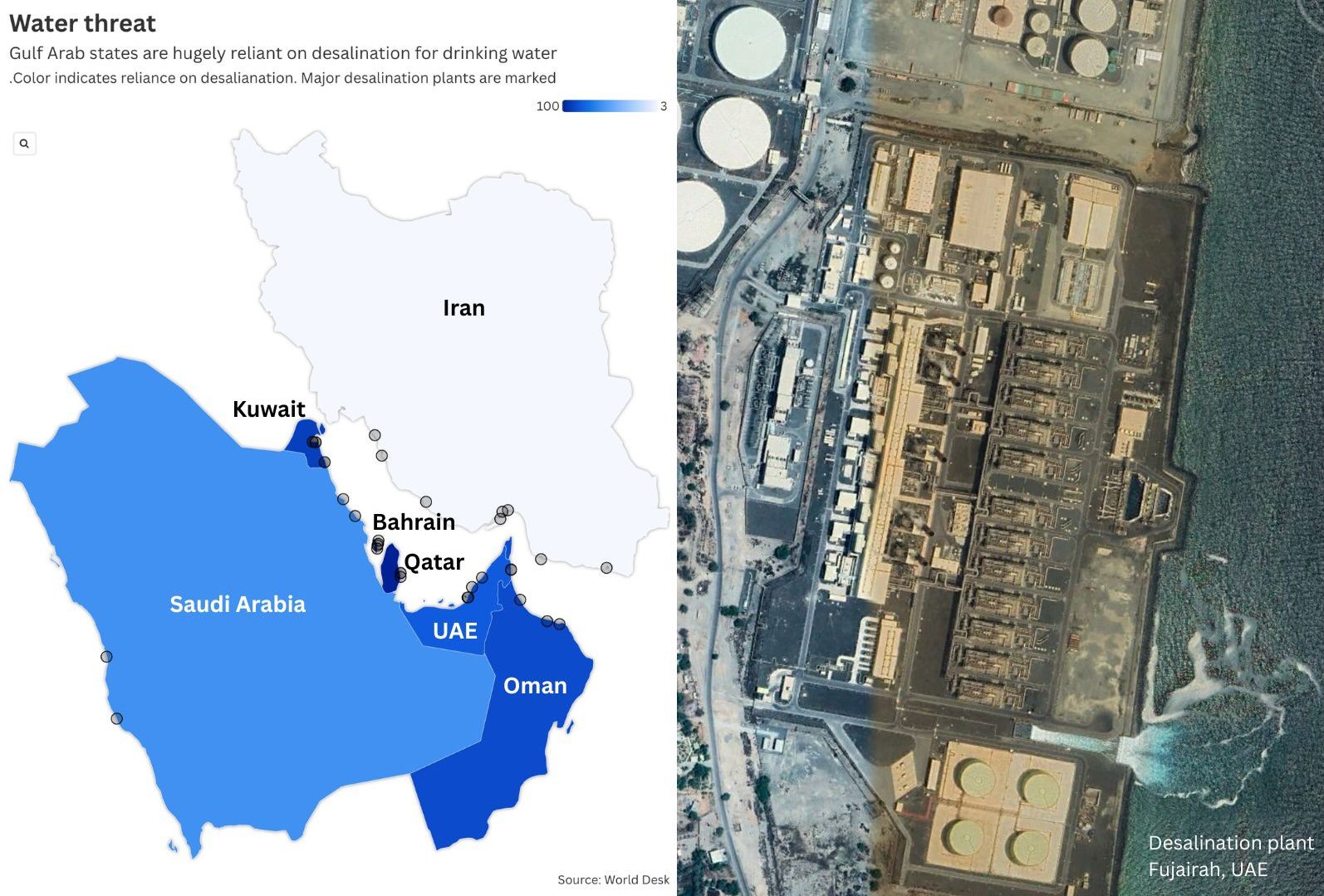
Since the war on Iran began on February 28, Iran has attacked Gulf desalination several times and it has kept running. Early in the conflict the Fujairah F1 complex in the UAE and the Doha West station in Kuwait were damaged by missiles or falling drone debris, and operations continued uninterrupted at both. Bahrain’s interior ministry said an Iranian drone struck one of its desalination centers on March 8 without affecting water supplies. By late April, an assessment for the Arab Center Washington DC concluded that damage from the attacks to that point had been limited and that no significant disruption to water supply had been reported.
July has not broken the pattern. Kuwait’s electricity and water ministry said a second power and desalination station in two days was struck on July 18, and that “another electricity and water distillation plant was targeted by a hostile attack that led to a fire erupting in one of the plant’s components,” deactivating generating units. The ministry activated emergency plans to keep electricity and water running with minimal disruption and asked the public to conserve power between 11 a.m. and 5 p.m. Taps did not run dry.
Iran Is Where Attacks On Water Have Actually Cut Supply
The verified interruptions have been on the other coast. At Bonji, the strike destroyed the seawater intake station and an electrical transformer, forcing the plant out of service in a province where summer temperatures routinely exceed 40 degrees Celsius. Iranian officials say earlier strikes in the Sirik area in June disrupted supplies for about 20,000 residents before repairs. The Qeshm Island plant, which Foreign Minister Abbas Araghchi accused the United States of hitting on March 7 with the warning that “the U.S. set this precedent, not Iran,” was still out of service a month later. Washington and Israel denied that strike; the US military has not specifically addressed the Bonji damage.
The GCC operates some 3,401 desalination plants producing 22.67 million cubic meters a day, a third of global capacity. Iran’s operational capacity is roughly 1 million cubic meters daily, about 4 percent of the GCC’s, spread across plants that are mostly small or medium-sized. In the Gulf, losing a plant means losing a fraction of a fraction. In Hormozgan, losing a plant means a district loses its water. Iran’s national reliance on desalination is low, but its Gulf-coast plants and inland transfer pipelines together supply an estimated 30 million people — a third of the population. Sanctions further constrain repair and replacement.
The Gulf’s Real Exposure Is The Grid, The Intake And The Clock
None of this means the Gulf is safe; but the threat model may have been misdirected. Roughly three-quarters of GCC desalination sits inside integrated power-and-water plants, so freshwater output can be cut by hitting the generation side — which is precisely what Kuwait reported this month. Desalination is also a linear process, and damage to high-pressure pumps or membrane buildings can disable production entirely, taking weeks to repair.
The systemic risks are worse than the point-target ones. In 1991, Iraqi forces destroyed most of Kuwait’s desalination capacity and dumped oil into the northern Gulf, forcing authorities to ration household water to four days a week and rely on tankers. A 2008–09 algal bloom shut installations in Oman and the UAE for up to two months. A weaponized spill in a semi-enclosed sea would not care how many plants a country owns.
And redundancy buys volume, not time. Bahrain’s government reports reserves for four days if desalination stops. The UAE’s 2036 water strategy would provide roughly two days at normal consumption, stretching to 16–45 days under emergency rationing. Bahrain, Kuwait and Qatar hold insufficient storage to buffer a serious interruption. Naser Alsayed, an environmental researcher specializing in the Gulf states, told Al Jazeera that effects would be felt most acutely in “smaller states that are highly dependent on desalination like Qatar, Bahrain, and Kuwait, which have minimal strategic reservoirs,” adding: “The most significant impact, in my view, is psychological.”
Geography Is Doing Work That Air Defense Cannot
The map matters as much as the inventory. Substantial capacity sits distant from Iran — Oman’s plants are primarily on the Sea of Oman, the UAE’s Fujairah complexes face the Gulf of Oman, and Saudi Arabia’s desalination corporation operates 12 plants on the Red Sea serving the kingdom’s west. Saudi Arabia’s Gulf-coast plants at Jubail and Ras al-Khair supply nearly 14 million people, a genuine concentration risk, but the kingdom is the least desalination-dependent GCC state and has an alternative coastline. Iran’s southern plants have no second sea.
Both sides invoke the same law. Article 54(2) of the 1977 Additional Protocol expressly prohibits attacking drinking water installations and supplies. Iran’s energy minister, Abbas Aliabadi, said the Bonji strike showed that “targeting desalination facilities that supply drinking water to thousands of innocent people constitutes a clear example of a war crime and a crime against humanity,” and said Tehran would pursue complaints in international courts. The Security Council, in Resolution 2817 of March 11, condemned Iran’s attacks on its neighbors “in the strongest terms” and called on Tehran to comply with international humanitarian law, particularly on civilian objects. Neither instrument has stopped anything.
The likely trajectory, if the tempo of US strikes and Iranian retaliation continues, is more of the same asymmetry: cumulative degradation of Gulf generation capacity that stops short of outages, and discrete, immediate water crises in Iranian coastal districts. Gulf capitals should read that as a reprieve rather than an all-clear. Their systems have absorbed drones; they have not been tested by a contaminated sea, a coordinated strike on cogeneration, or a cyber intrusion.
