
China’s Growing Show Of Naval Power Also Challenges The US
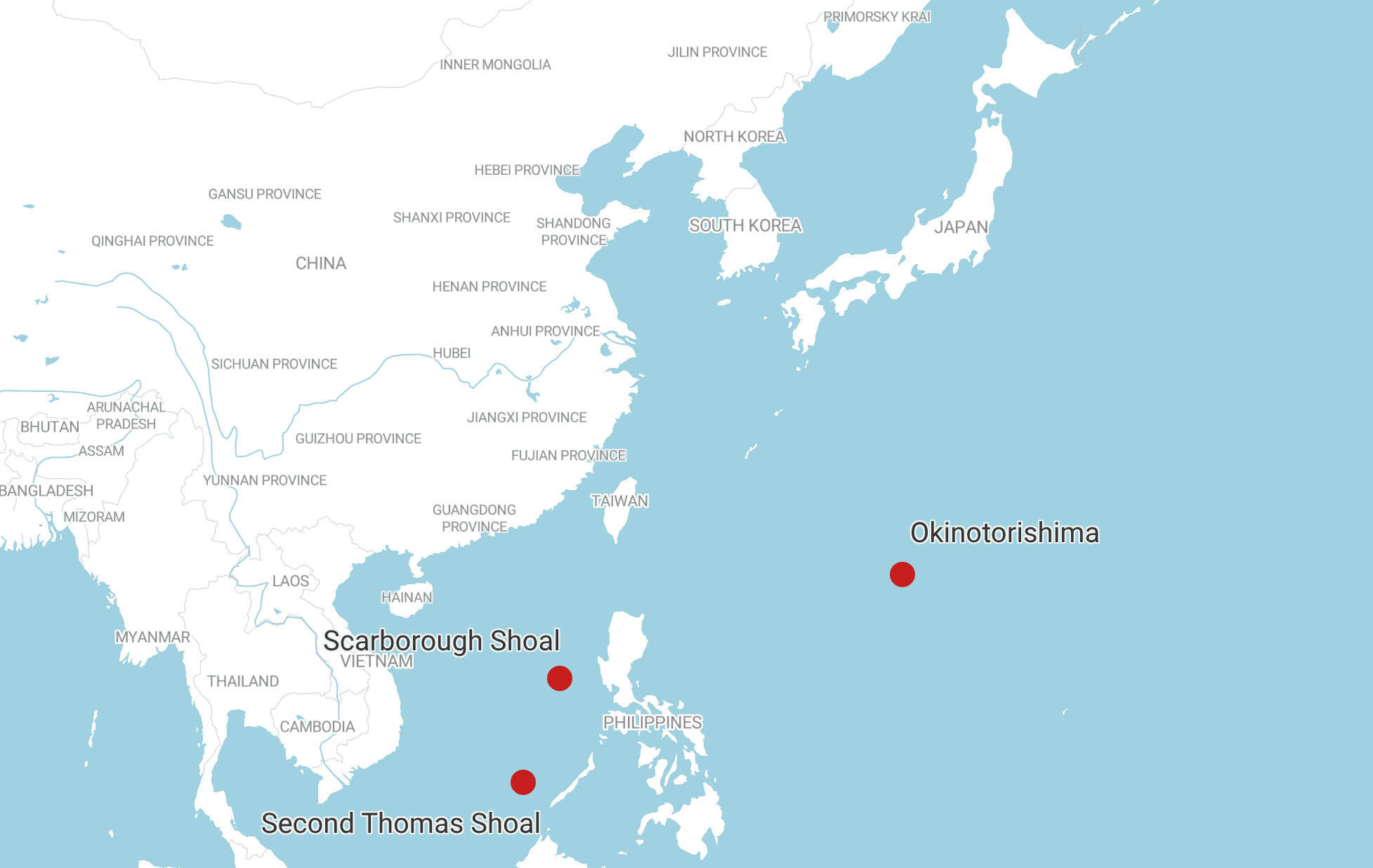
A Chinese warship opened fire in waters Japan calls its own, and Beijing answered the protest with a lecture on law from the very treaty whose application it rejects when it comes to its dispute with the Philippines.
The picture is of a China that is growing increasingly assertive against its neighbors as they themselves draw closer with the United States looming behind them.
Responding to the Japanese protest over the Chinese-Russian live firing exercise near Okinotorishima, Chinese foreign ministry spokesperson Lin Jian said that “by UNCLOS definition, Okinotori is a rock rather than an island, and thus unfit to claim EEZ or continental shelf,” and that Japan was “seeking excuses for accelerating remilitarization and challenging postwar international order.” Tokyo’s Chief Cabinet Secretary Minoru Kihara had been firm also, telling reporters: “We will continue to watch China-Russia operations around Japan with concern, while doing utmost for the warning and surveillance of the Japanese airspace and territorial waters.” Roughly a day later and 3,000 kilometres (1,900 miles) away, a Chinese coastguardsman split a Filipino sailor’s head open with a wooden baton.
These are not separate stories. They come at the same time as a stepping up of Chinese naval activity around Taiwan—and also with the United States distracted by the Iran war.
White Hulls Do the Work Grey Hulls Cannot
While the live-firing incident at Okinotorishima involved the People’s Liberation Army Navy, it is the coast guard that is doing the work in the Philippines. The tempo at Second Thomas Shoal had appeared to ease after June 2024, and Chinese pressure shifted to Scarborough Shoal, where coast guard presence more than doubled in 2025. The Philippine Navy counted 286 Chinese military vessels in the West Philippine Sea over the year. Then on 20 July a coast guard boat launched from cutter 21560 closed on the BRP Sierra Madre and a crewman struck a Philippine sailor with a baton — the worst injury yet in that dispute, inflicted without a weapon that would trouble a treaty lawyer.
The Law Is an Instrument, Selected by Result
Beijing’s legal posture tracks the same opportunism. The Article 121(3) test China invokes against Okinotorishima — rocks incapable of sustaining habitation generate no EEZ — received its only authoritative modern application from the 2016 arbitral tribunal, which used it to rule that none of China’s claimed Spratly features generates a 200-nautical-mile zone and that the nine-dash line has no legal basis. China called that award null and void.
China’s Okinotorishima argument is not completely frivolous: two rocks supporting a vast maritime claim is close to what Article 121(3) was written to prevent. And the award is not beyond criticism. But China did not argue the tribunal erred. It argued no tribunal had authority over China at all, refused to appear, and campaigned to discredit the proceedings. The claim is not about what the law says; it is about who may say it.
The Neighbours Are Converging — Which Is What Beijing Warns Against
Coercion at this scale generates its own opposition. Japan and the Philippines signed an Acquisition and Cross-Servicing Agreement in Manila on 15 January 2026, permitting reciprocal supplies and services during combined exercises and extending Japanese access to Philippine ports and airports, following the Reciprocal Access Agreement concluded in 2024. Analysts told Defense News that China’s initial coast guard patrols east of Taiwan responded to those very talks, pointing to Beijing’s condemnation of them.
The circularity is striking. Lin Jian warned as far back as 2024 that the region “does not need any military bloc, still less groupings that incite bloc confrontation or a new Cold War.” The bloc is assembling, and the recruiting is being done by Chinese cutters.
China’s pressure, calibrated to stay below the threshold of armed attack, is cheapest precisely when the region’s security guarantor has its attention and its munitions committed elsewhere—as the United States does in Iran right now. The likelier trajectory is not a crisis but continuation — more firsts, each smaller than a war and larger than the last, until the map Beijing describes and the map its neighbours accept have quietly drifted apart. The question for Tokyo, Manila and Taipei is not whether they can force China into a courtroom. It is whether they can raise the cost of each new precedent before it hardens into the next baseline.
